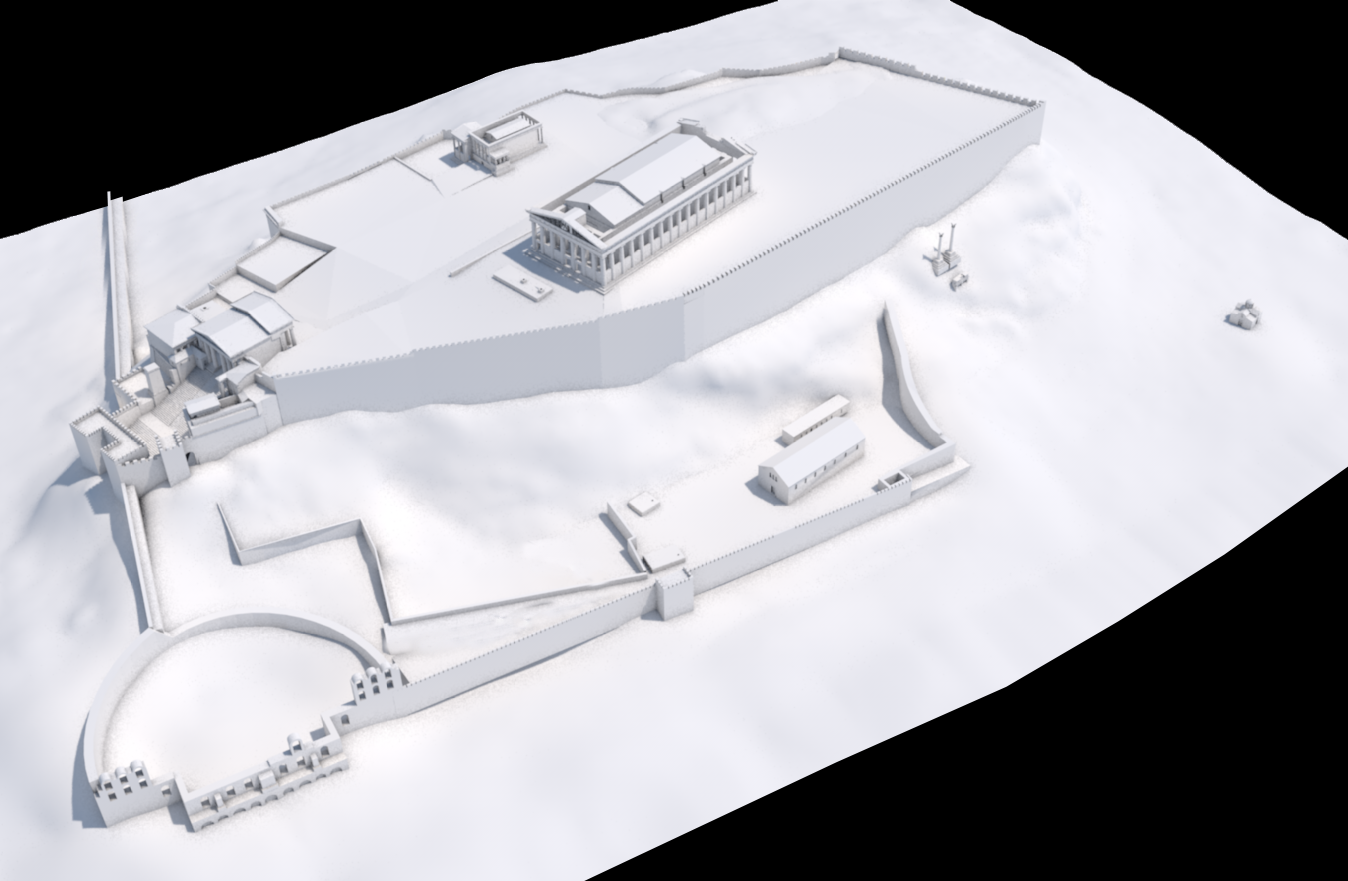
Byzantine
Barbarian invasions in the 3rd and 4th centuries AD and the ascendancy of Christianity brought about major changes to the monumental ensemble of the Acropolis. At the end of the 3rd century AD, the Acropolis was enclosed within the new Late Roman Fortification Wall, which surrounded the reduced city of Athens, while its western approach was fortified with a gate flanked by two massive rectangular towers. The fortifications were strengthened in the 6th century, while a large underground cistern was constructed to the northeast of the Propylaea. At around the same time, the Parthenon, the Erechtheion, the southwest wing of the Propylaea and the Temple of Athena Nike were converted into Christian churches. By the 12th century, the hill had been transformed into a medieval castle, with houses within its walls, the residence of the metropolitan bishop in the Propylaea and, in the Parthenon, the Panagia Atheniotissa, an important pilgrimage shrine throughout the Byzantine Empire. Small churches and cisterns had been constructed around the foot of the hill, while a Christian basilica stood on the site of the ancient Asklepieion.