Asklepieion
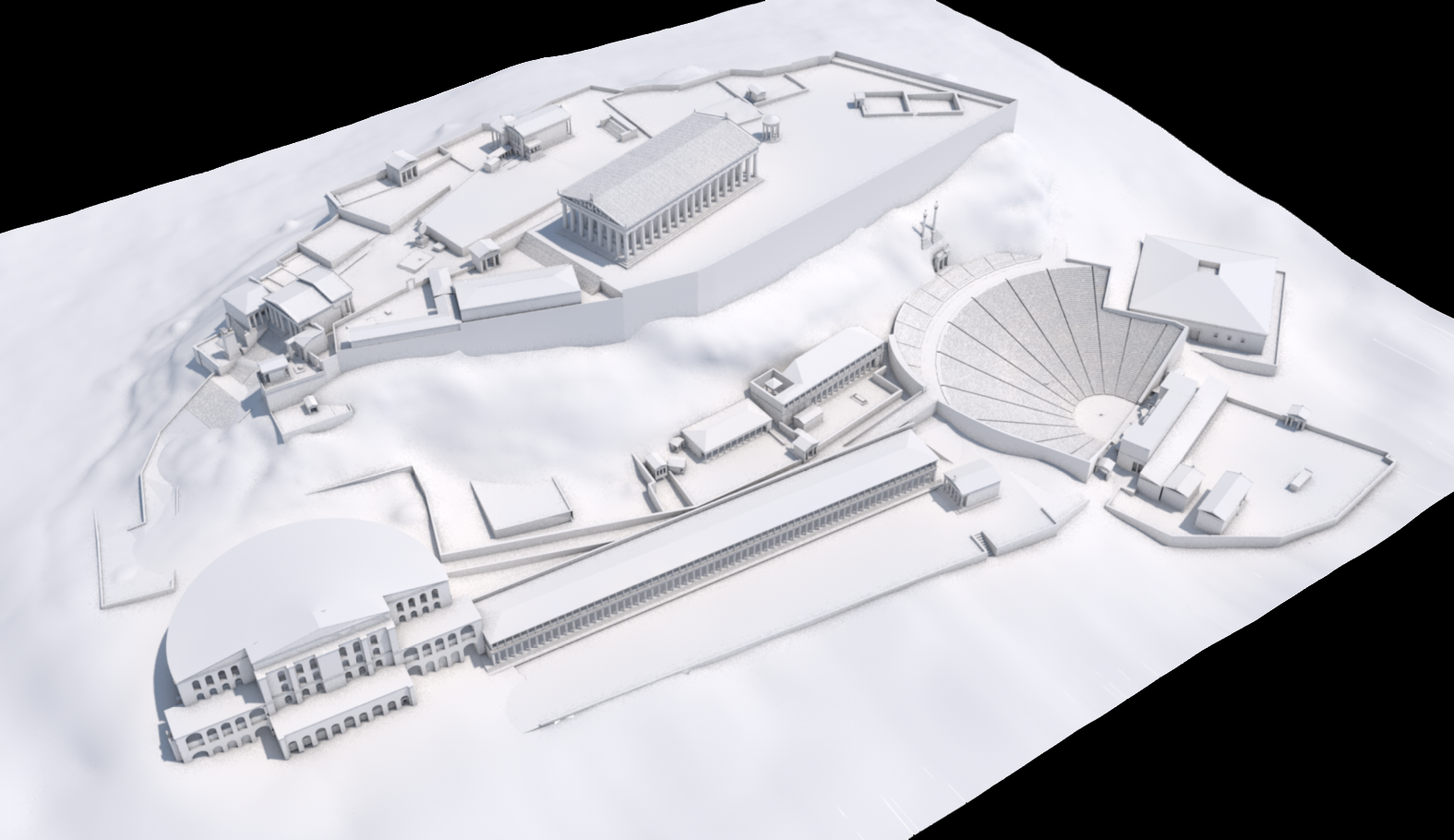
Asklepieion
The Asklepieion was founded in 420/419 BC by Telemachos of Acharnae, who introduced the cult of Asklepios to Athens from Epidauros. On its western side, the sanctuary was bounded by a precinct wall with a propylon opening towards the Peripatos road. The complex comprised the altar and temple of the god and two stoas: the Doric Stoa at its eastern end and the Ionic Stoa to the west. In the eastern part stood the small temple of Asklepios, probably a prostyle tetrastyle building, oriented east–west and measuring approximately 11 × 6 m; today it survives only at foundation level. West of the temple, in the late 5th century BC, the Ionic Stoa was erected, a rectangular building with four rooms and an Ionic porch facing south, which served as a dining facility and as accommodation for priests and visitors.
In 300/299 BC the large two-storeyed Doric Stoa was built north of the temple, measuring 49.88 × 9.915 m and functioning as an abaton or enkoimeterion, where patients stayed overnight and underwent ritual incubation for healing. The façades of both the ground and upper floors had 17 Doric columns, while the ground floor also had a second, internal Ionic colonnade. From the rear wall of the ground floor there was access to the Sacred Spring, a circular vaulted chamber cut into the rock, from which water emerged and was probably conducted through a system of channels inside the stoa before reaching a reservoir at the entrance to the sanctuary. At the western end of the stoa, at upper-floor level, the Sacred Pit was incorporated, a deep circular shaft lined internally with polygonal masonry dating to the last quarter of the 5th century BC and mainly associated with the chthonic and heroic aspects of the cult of Asklepios. Four column bases around it indicate that it was covered by a separate roofed structure.
During the 1st century BC, following the destruction caused by Sulla’s attack in 86 BC, the Sacred Spring and the propylon were repaired, and a new Ionic temple dedicated to Asklepios and Hygieia was erected, with two columns on the façade, a small cella and a pronaos. Restoration work was also carried out on the Doric Stoa. In the same period, the altar of Asklepios was refounded, with the reuse, among other material, of architectural members from the Erechtheion, the enclosure wall of the sanctuary and the Doric Stoa. During the Augustan period, a small Corinthian stoa was built south of the temple and has been associated with the building activity of the priest Zenon of Rhamnous. In the 2nd century AD the Asklepieion continued to function as an active healing sanctuary. Pausanias mentions statues of Asklepios and his children in the temple, as well as painted representations. After the Herulian invasion of AD 267, the temple was rebuilt on a larger scale and extended eastwards; architectural members from the earlier Roman temple were incorporated into the new construction.