Choregic Monument of Nikias
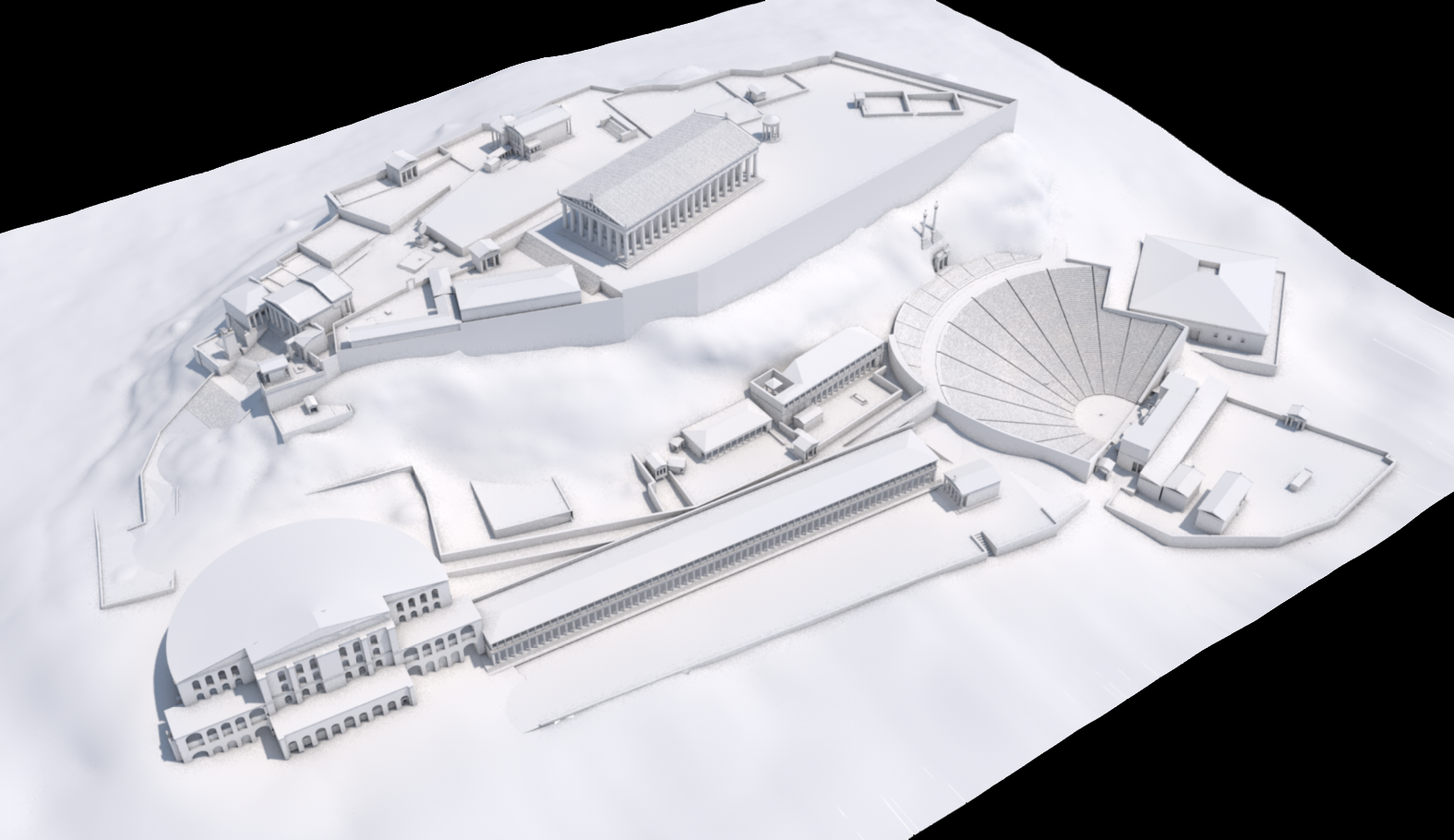
Choregic Monument of Nikias
Choregic monument erected in 320/319 BC by Nikias, son of Nikodemos, following his victory as choregos of a boys’ chorus at the Great Dionysia. It stood immediately south of the southeast corner of the Stoa of Eumenes and west of the cavea of the Theatre of Dionysus. It had the form of a prostyle hexastyle Doric naiskos, approximately 16.60 m long, with its façade facing west, a pitched roof, and pediments on both short sides. The foundations were constructed of conglomerate blocks and the euthynteria of reddish Acropolis limestone, while Piraeus limestone and Pentelic marble were used in the superstructure. The choregic inscription was carved on the three central blocks of the architrave. The bronze choregic tripod was placed either inside the cella or, more probably according to more recent studies, at the apex of the pediment of the façade as the central acroterion.
During the reign of the emperor Valerian (AD 253–260), or alternatively after the Herulian invasion of AD 267, the monument was dismantled and a large number of its architectural members were reused in the Western Gate of the Acropolis, known as the Beulé Gate.