Choregic Monument of Thrasyllos and Choregic Columns
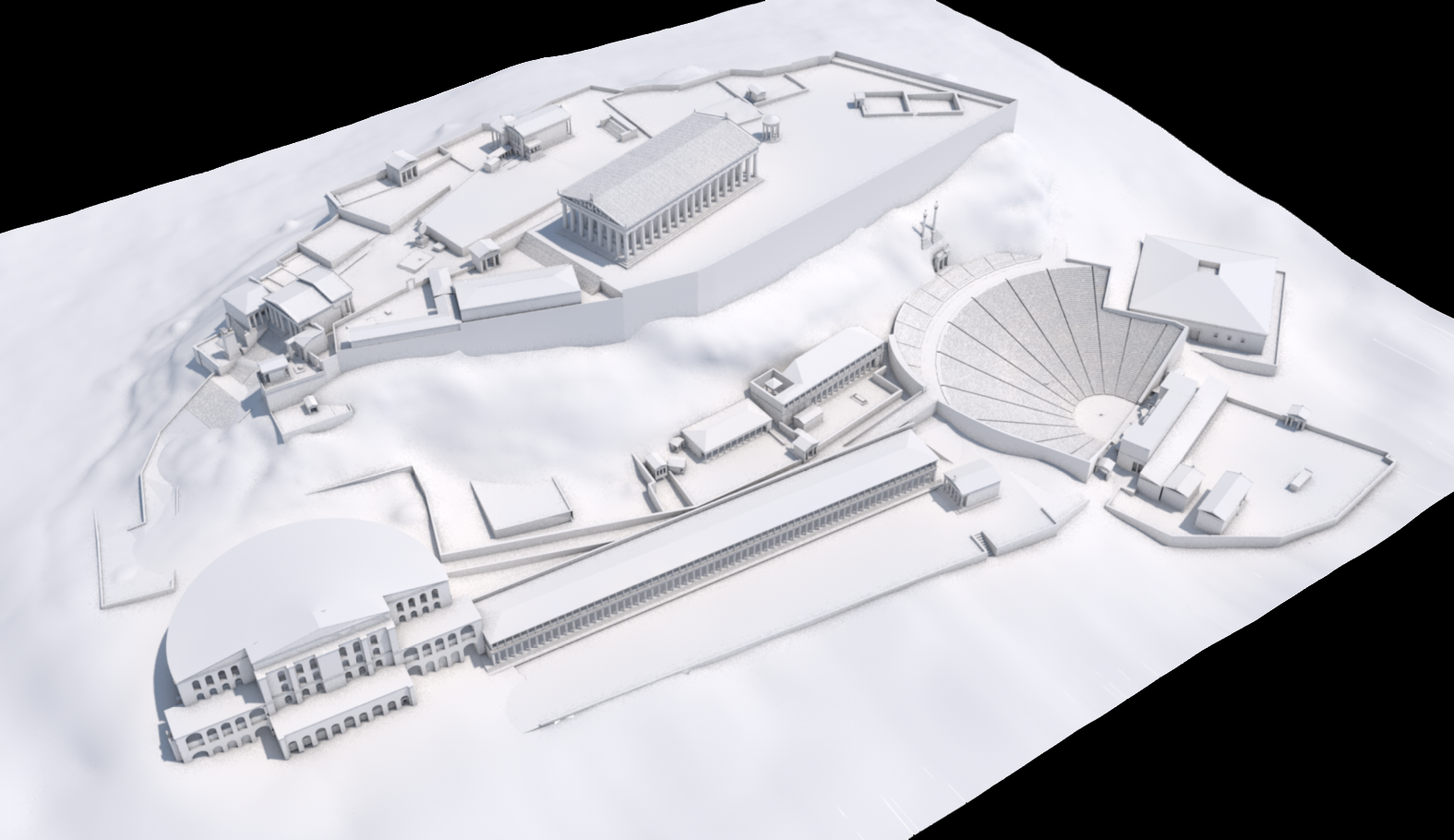
Choregic Monument of Thrasyllos and Choregic Columns
Choregic monument erected in 320/319 BC by Thrasyllos, following his victory at the Great Dionysia. It stood above the Theatre of Dionysus, at the mouth of the largest natural cavity in the southern face of the Acropolis rock. The façade was marble and had the form of a double-doored gateway, with two antae and a central pier, Doric capitals, and an architrave bearing the choregic inscription, as well as a frieze decorated with ten relief olive wreaths and a central ivy wreath. Above was an Ionic geison, on which the bases for the choregic tripods were placed. According to Pausanias, inside the cave there was a representation of Apollo and Artemis slaying the children of Niobe. At the top of the monument was a central three-stepped base carrying the bronze tripod commemorating Thrasyllos’ victory.
In 271/270 BC, Thrasykles, son of Thrasyllos, following two victories as agonothetes at the Dionysia, remodelled the upper part of the monument, adding two bases on either side of the central base for the placement of his own choregic tripods.
On the rocky plateau immediately above the Choragic Monument of Thrasyllos, two free-standing, unfluted Corinthian choregic columns rise on stepped bases. The columns are crowned by three-sided capitals, on which choragic tripods were set. They date to the late 4th or early 3rd century BC.