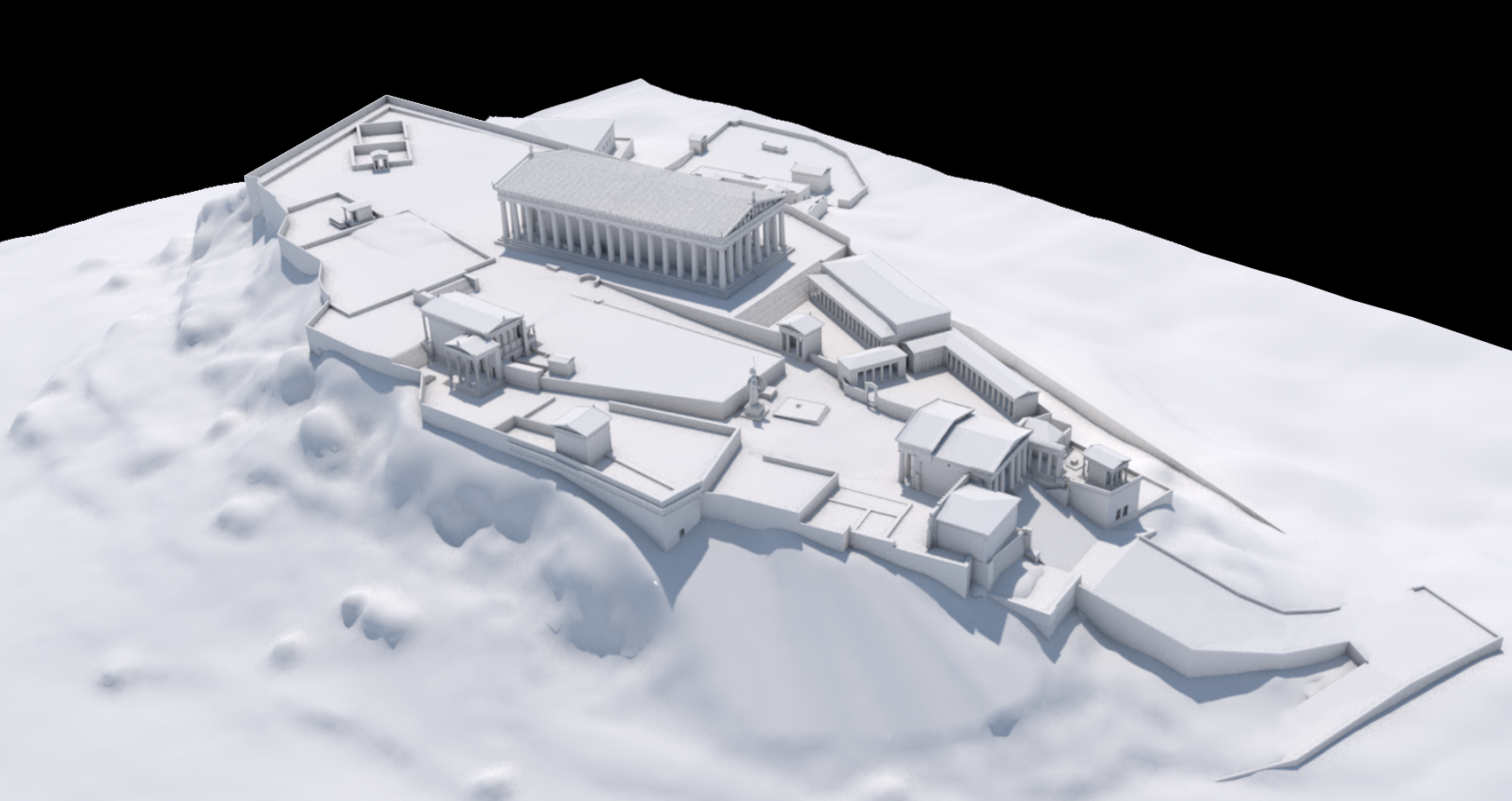
Sanctuary of Aphrodite and Eros
Sanctuary of Aphrodite and Eros
Open-air sanctuary in the eastern part of the north slope, bounded to the south and west by the rock of the Acropolis. The sanctuary is arranged on two terraces. The first terrace lies at a higher level and is accessible from the east by means of a sloping earthen ramp approximately 15 m long. Two rock-cut inscriptions are preserved in this area, dating to ca. 450–430 BC: one is a dedication to Aphrodite, while the other is a sacred law indicating that a festival in honour of Eros was celebrated on the fourth day of the month of Mounichion (late April–early May). To the north, the upper terrace must have been bounded by a wall, on the line of which a later wall was constructed by the excavators of the site in order to retain the fill. The second terrace lies at the level of the Peripatos. Low built structures stood in this area and served as altars for the offering of bloodless sacrifices. Two column drums from the Pre-Parthenon were found at this spot; they had rolled down from the Acropolis wall, into which they had been incorporated after the end of the Persian Wars. In total, more than 23 niches for the placement of votive offerings had been cut into the rock of the sanctuary. The sanctuary has been associated by some scholars with the ritual of the Arrhephoria, during which, according to Pausanias, young Athenian girls carried secret offerings by night from the Acropolis through a hidden underground passage, deposited them in the sanctuary, and took others from there to carry back up to the Acropolis.