Pre-Parthenon
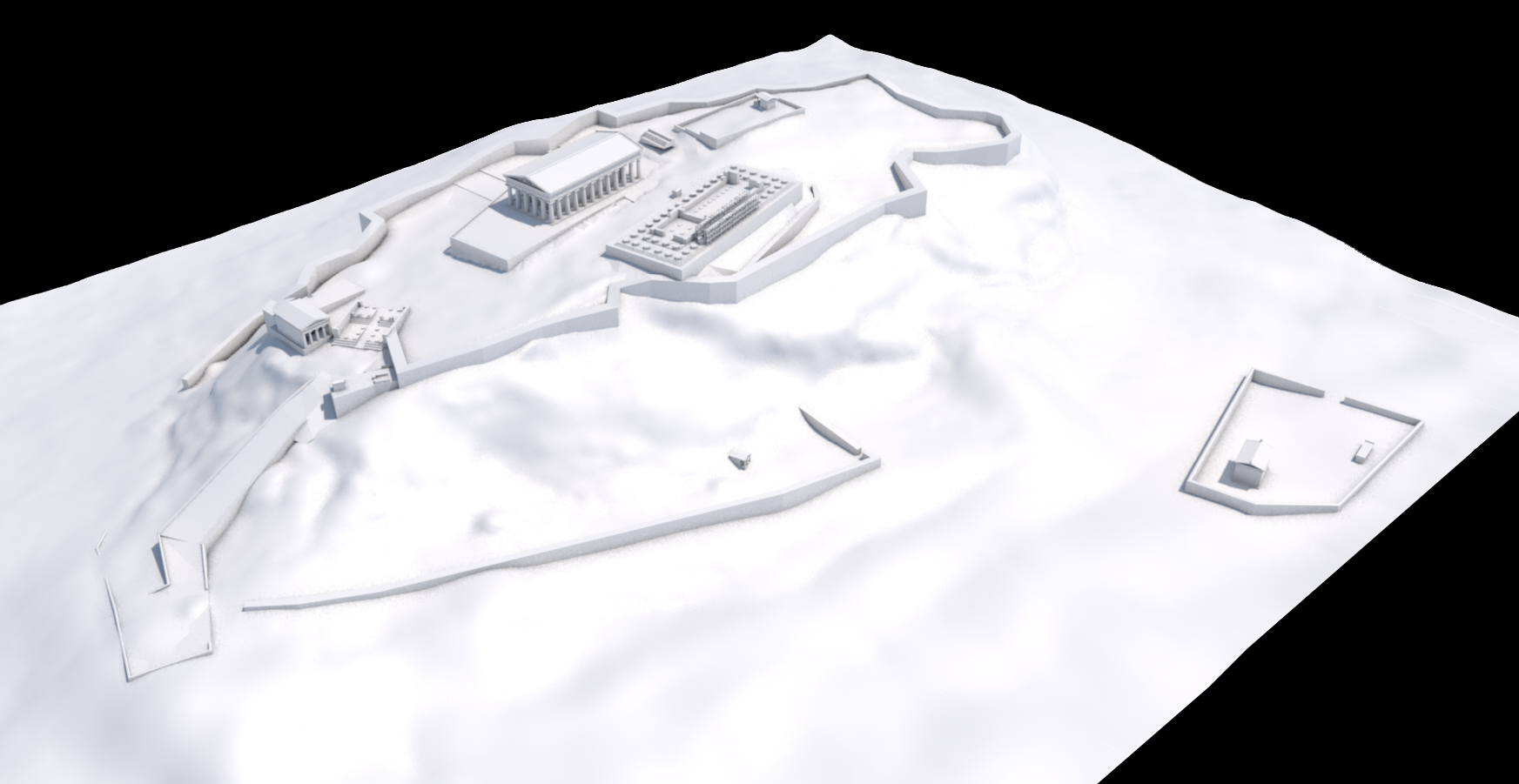
Pre-Parthenon
Unfinished marble peripteral Doric temple on the site later occupied by the Classical Parthenon. Its construction began after the Battle of Marathon, in 490 BC. The temple was founded on the large stereobate which had been constructed in the late 6th or early 5th century BC for a larger, unfinished poros peripteral temple with a colonnade of 6 × 15 columns; the dimensions of its ground plan were subsequently modified for the construction of the new, smaller marble temple. Built of Pentelic marble on a three-stepped crepidoma of limestone and marble, the new temple measured 66.9 × 23.6 m and had a peristyle of 6 × 16 columns. The columns were of the same diameter as those of the later Periclean Parthenon, although the intercolumniations were slightly wider. The cella was divided into two self-contained compartments with no internal communication between them. The larger eastern compartment contained two parallel rows of interior columns, while the smaller western compartment had four columns that would have supported the roof. Tetrastyle prostyle porches stood at the east and west ends of the cella. Construction of the monument appears to have been suspended around 485 BC, when the death of Darius and the accession of Xerxes made it clear that the Persian threat had by no means disappeared, prompting a shift in Athenian priorities towards strengthening the city’s defences in anticipation of renewed danger. By that time, however, construction had advanced considerably: the peristyle and the interior colonnade had risen to approximately the level of the third or fourth column drum, while the moulded wall base of the cella walls had already been constructed. In 480 BC, when the Persians invaded Athens, the unfinished temple was burned and destroyed. It was eventually replaced, in the early years of the second half of the 5th century BC, by the magnificent and unique Periclean Parthenon.